
Basement insulation in Wildomar CA - a lower level that holds its temperature
Cold floors over the basement or a climbing power bill? We insulate the basement walls or the floor above so your house holds its temperature.
- Licensed and insured.
- Free in-person estimates.
- We respond within 1 business day.
Should you insulate the basement walls or the floor above?
Basement insulation in Wildomar means adding insulation to the foundation walls, usually from the inside on an existing house, or to the floor over the basement, so the lower level and the rooms above stop losing heat.
Most people who call me about a basement have cold floors upstairs, a lower level nobody wants to sit in, or old insulation down there that may need insulation removal before anything new goes in. The price turns on the square footage, whether we insulate the walls or the floor above, whether the walls are bare or finished, and which material you pick. The schedule turns mostly on what has to be fixed first, like a leak or pest damage, and on the permit step if your job has one. When I come out, you get a price for each option so you see your own numbers before you decide.
How do you know your basement needs insulation?
Cold floors upstairs
The rooms over the basement feel cold underfoot in winter and you keep nudging the thermostat up. That usually means bare foundation walls or an uninsulated floor are letting heat slip down, and every month you wait, you're paying to heat the ground.
Bare concrete all around
You can stand in the basement and see raw foundation on every wall. Concrete passes the ground's temperature straight through, so the space stays cold and the rooms above work harder to stay comfortable.
Damp smell or wet spots
A musty smell, a water line on the wall or white crust on the concrete means moisture is getting in. That has to be found and fixed before any insulation goes up, because covering it only hides it while it gets worse behind the wall.
How we do basement insulation
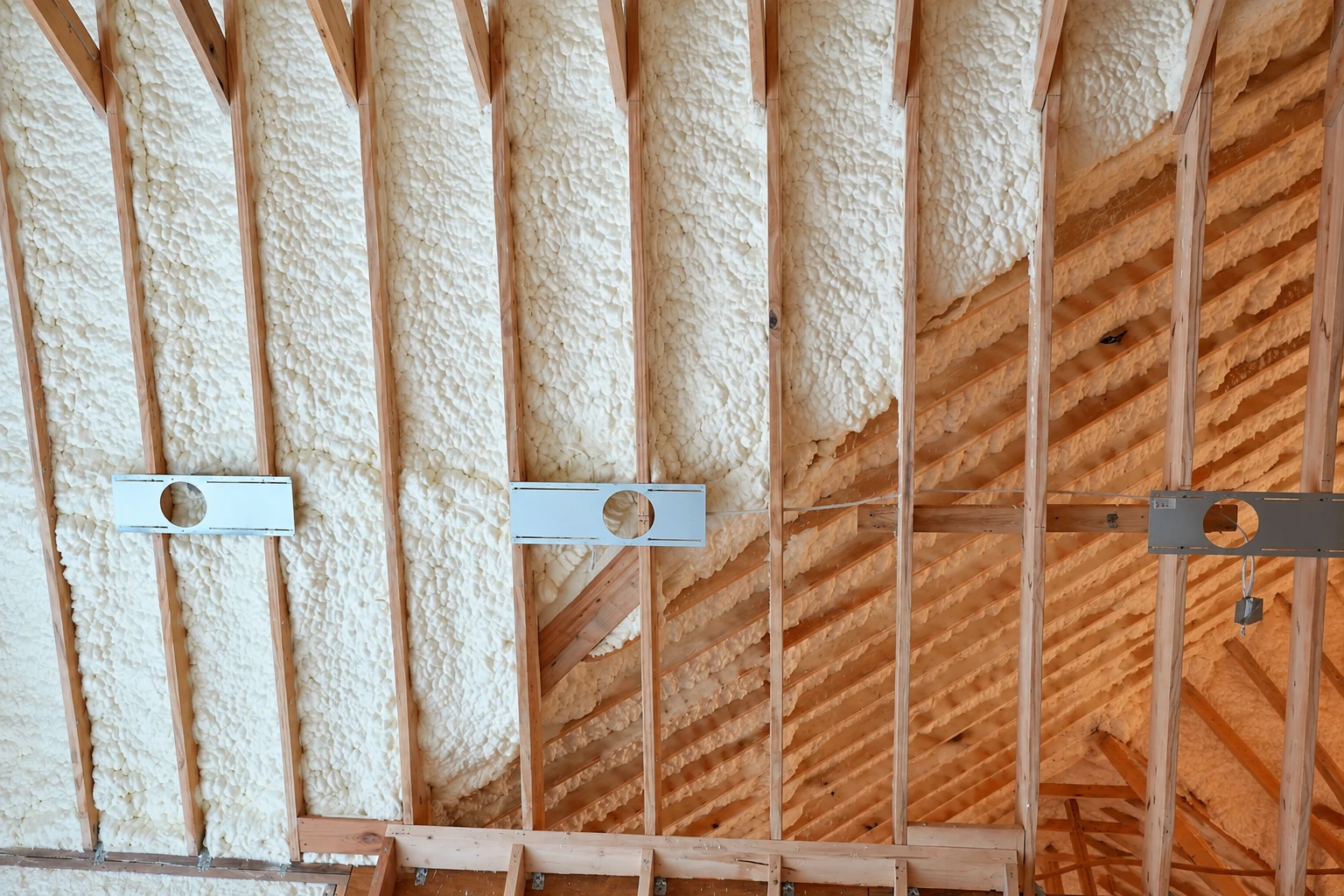
I look the basement over first, then I price both the walls and the floor above so you can weigh cost against how well each one performs. Most of the work happens from inside, because digging out around an existing foundation to insulate it from the outside, where it works best, usually isn't practical. On bare walls we can spray foam right onto the concrete, set rigid foam panels, or frame a wall and fill it with batts or with loose fill blown in through a hose before drywall goes on. Foam on a basement wall has to be covered with drywall to meet the building code, so any foam estimate you get should include that board. A finished basement can often be blown in through small holes, so the walls you have can stay.
For foam on the walls, closed-cell foam insulation is the dense kind that also blocks moisture, which is why it's the usual pick against concrete that touches the ground. Open-cell foam insulation is softer and costs less, and it belongs up in the floor framing more than against a damp wall. Foam costs more than a framed wall with batts, but it seals air and insulates in one pass, so on bare walls I usually lean toward it unless your budget points to the floor instead.
Foam on bare walls
This suits an unfinished basement you want to use, because the foam goes straight onto the concrete and seals as it insulates. It costs the most up front and needs drywall over it before the job is done.
Framed wall with batts or loose fill
This suits owners who are finishing the basement anyway, since the framing and drywall are already part of the plan. It usually costs less than foam, but the room-side moisture layer has to be right, which the questions below cover.
Insulating the floor above
This suits owners who want the rooms upstairs warmer for less money and don't use the basement much. The basement itself stays cooler, and that's the trade you make for the lower price.
Get your basement priced both ways, walls and floor
Send your basement's rough square footage and whether the walls are bare or finished. We get back to you within one business day to set up a free on-site estimate, with no pressure and no obligation to go ahead.
- Based in
- Wildomar, CA 92595
- Hours
- Mon–Fri: 6 AM–11 PM, Sat–Sun: 8 AM–9 PM
What happens after you call about your basement?
Here's how a basement job runs from your first call to the final walk-through, and who you'll be dealing with at each step.
Call or send the form
You call (951) 417-1017 or send the form, and we get back to you to set a time for me to come out. It helps to tell us roughly how big the basement is and whether the walls are bare or finished.
I look at the basement
I check the walls, the floor above and anything that needs fixing first, and before I leave I tell you what I'd do, what I'd skip and why. You leave with a price for the walls and a price for the floor, so the cost is on the table before you decide anything.
We handle the permit step
Once you say go, we check the permit step for your address and file it if one is needed. Construction in Wildomar runs Monday through Saturday from 6:30 am to 7:00 pm, with none on Sundays or city holidays, so we schedule your install inside those hours.
Seal, insulate, then walk through
Our small crew, with me working alongside, closes the gaps around pipes, wires and openings first and then insulates, so the new material isn't fighting a draft. When we're done, we walk the finished basement with you.
Why Wildomar homeowners call us about their basements
I look before we quote
I come out to your house myself, look at the basement and the floor above, and plan the job before our small crew does the install alongside me. If a leak or a bad wire needs fixing first, I'll tell you that before I try to sell you any insulation.
In business since 2013
I started this business in 2013 after a childhood spent following my dad through attics and crawl spaces on his insulation jobs. That's 13 years of seeing what goes wrong when insulation goes in over a problem or in the wrong order.
Licensed and insured for this work
We're licensed and insured. In California, anyone altering a building needs a license from the Contractors State License Board when labor and materials together come to $500 or more, and they need it before they bid, so ask any contractor for theirs before you sign.
Call (951) 417-1017 or send us the form with your basement's rough size, and I'll come out and take a look.
Basement insulation, permits and termites in Wildomar
The City of Wildomar issues construction permits for work that meets code, but its permit list names building, electrical, plumbing and mechanical permits and not basement insulation, so the list alone doesn't settle whether your job needs one. You can ask the city's building and safety department about your address, and once you hire us we check the permit step with the building office ourselves and file it when one is needed. California's Energy Code also sets some standards for a home's outer shell based on the climate zone it sits in, which is one more reason we check before we start.
Wildomar's building design criteria rate the termite risk here as very heavy. Where termites are a concern, federal guidance calls for a gap between the top of the insulation and any wood so termites can still be spotted, and I'll go over that gap with you when I plan the job. We plan basement work the same careful way in Murrieta and Lake Elsinore.
Questions about basement insulation in Wildomar
How much does basement insulation cost in Wildomar?
Across the US, insulating a basement usually costs about $4.40 to $6.40 per square foot, and that's the general market range, not our price. Your number depends on the square footage, walls or floor, bare or finished walls, the material you choose and the drywall a foam job needs. Our work comes with satisfaction guaranteed on every job.
Is it better to insulate basement walls or the floor above?
Insulating the walls generally performs better, but it's often more expensive than insulating the floor over the basement. Some owners pick the floor purely to save money, and that's a fair call if the basement is mostly storage. If you spend time down there, the walls are usually worth the extra.
Can a finished basement be insulated without putting up new walls?
Yes, often it can. Holes are drilled in the existing walls and insulation is blown into the framing cavities, so the walls you have stay up. Whether it works on yours depends on what's behind the drywall, which I check when I come out.
How do I keep moisture out of insulated basement walls?
Fix any water coming in first, then use the right room-side layer for the insulation you pick. With fiberglass and similar insulation, guidance calls for Kraft-faced batts, which have a paper backing, or latex paint on the drywall to slow moisture on the room side. Plastic sheeting or foil facings on that side can trap moisture inside the wall.
How do I get my basement ready for insulation?
Start with an inspection for asbestos, lead paint, water coming in, moisture and pest damage, so any repairs happen before insulation covers them. Federal checklist guidance has the owner get a list of those problems before work goes ahead. Guidance also calls for confirming that the furnace and other fuel-burning appliances run safely before and after the basement is sealed and insulated.
Who issues construction permits in Wildomar?
The City of Wildomar's building and safety department issues construction permits for projects that meet code. As we cover above, its list doesn't name basement insulation, so we check the permit step for your address, with the city or the county, and file it when one is needed.
Foam options that pair with basement work
Closed-cell foam insulation
If your basement walls sit against damp ground, this dense foam insulates and holds back moisture in one layer, which suits concrete better than most materials.
Open-cell foam insulation
A lighter, softer foam that fills odd-shaped framing bays and costs less than closed-cell, a fit for the floor above a basement or interior walls.
Get your basement looked at first
Getting it insulated before you finish the basement is easier than opening new drywall later, so call (951) 417-1017 or send the form.